
'We're putting a lot of focus on GenAI developers and people who can really do all the architecture and programming.'

FMCG major Britannia Industries' results for the January-March quarter (Q4) of the financial year 2023-24 (FY24) were received enthusiastically by the market with the share going up by 6.7 per cent on Monday to close at Rs 5,061.60 on the BSE. However, analysts said the results were in line with margins, and disappointing in terms of revenue growth. The consolidated net sales (excluding other operating income) rose 3 per cent year-on-year (Y-o-Y) to Rs 4,010 crore in Q4.

Even though Bharat Forge's performance in the July-September quarter broadly met Street estimates and defence orders are on the rise, the subdued outlook for its global business has prompted some brokerages to adopt a cautious stance on the company. Analysts have reduced the company's earnings per share (EPS) estimates to account for the slow recovery of its overseas subsidiaries. Valuations are also trading at long-term averages, which could limit potential upsides.

Among the Sensex firms, IndusInd Bank, Maruti, Titan, Reliance Industries, NTPC, Mahindra & Mahindra, Larsen & Toubro, Kotak Mahindra Bank and HDFC Bank were the major laggards. UltraTech Cement, JSW Steel, Axis Bank, Tata Consultancy Services, Wipro and ITC were the major gainers.

NMDC, the country's largest iron-ore miner, posted a consolidated revenue in the January-March quarter of FY24. This was in line with estimates at Rs 6,500 crore, which was up 11 per cent year-on-year (Y-o-Y), and a 20 per cent quarter-on-quarter (Q-o-Q) rise on the back of realisations. Iron-ore production was 13.3 million tonnes (down 6 per cent and up 8 per cent Q-o-Q), while the sales stood at 12.5 MT (up 1 per cent Y-o-Y and up 10 per cent Q-o-Q).

rediffGURU Ramalingam Kalirajan answers your personal finance queries.

'Investors should focus on largecap funds, flexicap funds, business cycle funds, or hybrid-category funds.'

RBI Deputy Governor K C Chakrabarty said the central bank will come out in June with its next financial stability report, which showcases the country's financial strength, and

Operating margins have been the primary driver of corporate earnings in India in recent quarters, despite revenue growth suffering from weak consumer demand. Companies across sectors have reported a sharp improvement in earnings before interest, tax, depreciation, and amortisation (Ebitda) margins over the past two years, benefiting from lower commodity and energy prices. Higher margins more than compensated for slower revenue growth, resulting in double-digit growth in net profit for five consecutive quarters.

Retail inflation declined to a three-month low of 5.1 per cent in January, mainly due to subdued prices of vegetables, fruits and other food items, according to government data released on Monday. The fall indicates that retail inflation is inching towards the Reserve Bank's comfort level of 4 per cent. The Consumer Price Index (CPI) based inflation was on the rise for two straight months after touching a trough of 4.9 per cent in October 2023. In December, it stood at 5.69 per cent.

'The deal pipeline across products is robust for 2024.'

Titan Company on November 21, became the second Tata group firm to join Rs 3 trillion market capitalisation (market cap) club after its shares hit a new high of Rs 3,400, up nearly 2 per cent on the BSE in Tuesday's intra-day trade. At 12:28 PM; with a market cap of Rs 301,847 crore (Rs 3.02 trillion) Titan stood at number 16th position in overall market cap ranking on the BSE listed companies, the exchange data shows. Titan overtook paint company Asian Paints, which has a market cap of Rs 300,579 crore, data shows.

The advanced economies have been experiencing their longest period of slow growth in many decades.

Gold is an excellent asset class for diversification and should be included in all long-term portfolios.

To tell us about your father, just mail us at getahead@rediff.co.in (subject: My father) along with your name, the place where you live, your father's name and picture and your message about him.

The rating outlook change is relevant now, as the US Federal Reserve is set to end its monthly bond-buying programme in October.

Tactical investors should have an investment horizon of around six months to one year, long-term investors should stick around for 10 years or more.

Marico's January-March quarter (Q4) results were slightly better than consensus. Revenue was up by 1.7 per cent year-on-year (Y-o-Y) to Rs 2,280 crore. Ebitda grew by 12.5 per cent Y-o-Y to Rs 440 crore. Adjusted PAT was up 10.3 per cent Y-o-Y to Rs 320 crore.

A lot depends upon the crucial decision-making skills of the management. If you have any doubts about the management then you always have the choice of selling your shares or not buying stocks of those companies at all.

'Banks make money because they take the right credit calls. So they need to focus on risk mitigation rather than risk avoidance.'

S&P Global Ratings has upgraded its long-term ratings on Tata Motors to speculative grade 'BB' with stable outlook on earnings improvements and potential deleveraging. The ratings agency had earlier placed Tata Motors in 'BB-'. As per S&P ratings, a BB grade is less vulnerable in the near-term but faces major ongoing uncertainties to adverse business, financial and economic conditions.

For long-term financial security, millennials must not only provide social security for their young families but also ensure that their financial burdens are not passed down to their families, says Casparus Kromhout.
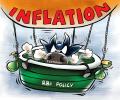
The Reserve Bank of India on Thursday marginally lowered its inflation projection for the current financial year to 5.1 per cent, as Governor Shaktikanta Das said the central bank's monetary policy actions are yielding the desired results. In April, the Reserve Bank had estimated the consumer price index (CPI) based retail inflation at 5.2 per cent during the fiscal 2023-24. CPI inflation fell sharply to 4.7 per cent in April 2023, from 6.4 per cent in February, on the back of favourable base effects, with softening observed across all the three major groups.

Global trends and trading activity of foreign investors would largely dictate terms in the equity markets this week amid a lack of major domestic triggers, analysts said. Markets may face near-term consolidation due to elevated valuations, they noted. "While the previous week was predominantly shaped by developments in the US Federal Reserve policy, attention will now shift to the Bank of Japan's policy decision on December 19," Santosh Meena, Head of Research, Swastika Investmart Ltd, said.

From the Sensex pack, Bharti Airtel, HDFC Bank, Titan, UltraTech Cement, ITC, Sun Pharma, Bajaj Finserv, Bajaj Finance, Hindustan Unilever and Kotak Mahindra Bank were among the major gainers. Tata Steel, Axis Bank, NTPC, ICICI Bank and IndusInd Bank were the major laggards.

Retail sales of automobiles in the domestic market saw a 7.73 per cent year-on-year decline in October this year at 21,17,596 units, mainly due to dip in two-wheeler uptake with the inauspicious period of Shraddh affecting new purchases, the Federation of Automobile Dealers Associations (FADA) said on Monday. Retail sales of automobiles in the domestic market stood at 22,95,099 units in October 2022, FADA said in a statement. Two-wheeler retail sales were at 15,07,756 units last month, as against 17,25,043 units in the year-ago period, down 12.60 per cent, as per the latest data by FADA.

From the Sensex pack, Infosys tanked over 8 per cent after the company reported a lower-than-expected 11 per cent rise in net profit for the June quarter and delivered a shocker as it slashed its FY24 growth outlook to 1-3.5 per cent on delayed decision-making by clients amid global macro uncertainties. Hindustan Unilever, HCL Technologies, Wipro, and Tech Mahindra were the other major laggards. On the other hand, Larsen & Toubro rose the most by 3.88 per cent after it bagged an order of worth over Rs 7,000 crore from the bullet train project.

A cocktail of heatwave and upcoming cricketing events is expected to usher in the peak season for the country's largest beer maker, United Breweries. The beer maker, which has gained share in some key markets, will be a major beneficiary as April to July is an important period contributing to 40-45 per cent of its annual beer volumes. Going ahead, the T20 Cricket World Cup in June and the ongoing IPL will have a positive impact on volumes and should be able to offset the negative impact of elections on sales, experts believe.

Analyst are cautious about the performance of IT services sector from January to March quarter (Q4) of FY24 and the first half (H1) of FY25. While the Bloomberg consensus on revenue implies the market is expecting 2-3 per cent growth on a quarter-on-quarter (Q-o-Q) basis for the IT majors through FY25, the H1FY25 is likely to see even flatter returns, and Q4FY24 is likely to be poor. There is likely to be some recovery in the second half (H2FY25) but even so, there's a chance that the market will be overall disappointed.

Among the Sensex firms, State Bank of India, Infosys, Titan, Tech Mahindra, IndusInd Bank, NTPC, ICICI Bank, Power Grid, Reliance Industries and Kotak Mahindra Bank were the major laggards. On the other hand, Tata Motors, Nestle, Hindustan Unilever, Tata Steel, Bajaj Finance and UltraTech Cement were among the gainers.

It has mostly been a one-way street for smallcap stocks that have taken it on their chin thus far in February. The Nifty Smallcap 250 index has shed 3.2 per cent in the current month as compared to the 1.8 per cent decline in the Nifty Midcap 100 and the 0.5 per cent drop in the Nifty 50 index, data showed. Technically, the index has slipped below its 20-day moving average (DMA) placed at 14,800 levels on Monday, and is currently testing the 50-DMA, and is placed at 14,278 levels.

Among the Sensex firms, Larsen & Toubro, UltraTech Cement, JSW Steel, Titan, Bajaj Finance, Wipro, Tech Mahindra and Nestle were the major laggards. Maruti, Power Grid, Axis Bank, State Bank of India, NTPC, HDFC Bank, ITC and IndusInd Bank were the gainers.

'Like every Budget, this time, too, there is chatter around tinkering with the long-term capital gains tax.' 'Investors may not want to jump into the markets until there is clarity on this front.'
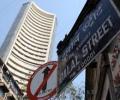
S&P upgraded India's credit outlook to 'stable' from 'negative' earlier.

From almost 60 per cent as of December 2019, the share of liquidations in the mode of closure of total Insolvency and Bankruptcy Code (IBC) cases came down to 44 per cent till September 2023, data by the Insolvency and Bankruptcy Board of India (IBBI) shows. Experts say the decreasing trend in liquidations under the IBC in India can be largely attributed to the initial economic conditions of companies entering the Corporate Insolvency Resolution Process (CIRP). IBC experts also say the trend shows a certain stabilisation in IBC with the Code now rid of legacy bankruptcy issues.

IT company Wipro on Wednesday reported almost flat growth in consolidated net profit at Rs 2,667.3 crore for the September 2023 quarter and projected a 3.5 per cent fall in revenue in the current quarter on a weak global economic outlook. The company had posted a profit after tax of Rs 2,649.1 crore a year ago. Its lower IT services growth estimate for the December 2023 quarter by 3.5-1.5 per cent is in the range of $2,617-2,672 million in constant currency terms or about Rs 21,642.59 -- Rs 22,097.44 crore.

Taxing the rich will fetch nothing; only votes, argues Debashis Basu.

Indian growth in the rest of this fiscal year and next will be propelled by robust domestic consumption as consumer confidence improves, and by investment, including large increases in government capital expenditure, according to the Asian Development Outlook September 2023. "As slowing exports could foment headwinds for the economy, and erratic rainfall patterns are likely to undermine agricultural output, the growth forecast for FY2023 is revised down marginally to 6.3 per cent," ADB said.

In a remarkable comeback, foreign portfolio investors (FPIs) have pumped Rs 1.7 lakh crore into the Indian equity markets in 2023, propelled by confidence in the country's robust economic fundamentals amid a challenging global landscape. The year 2023 has witnessed massive investment by FPIs, thanks to the sharp uptick in inflows of Rs 66,134 crore in December. Going forward, FPI flows are expected to be robust.

'The UK is more of a structural problem, and that's why we're doing the restructuring.'
